


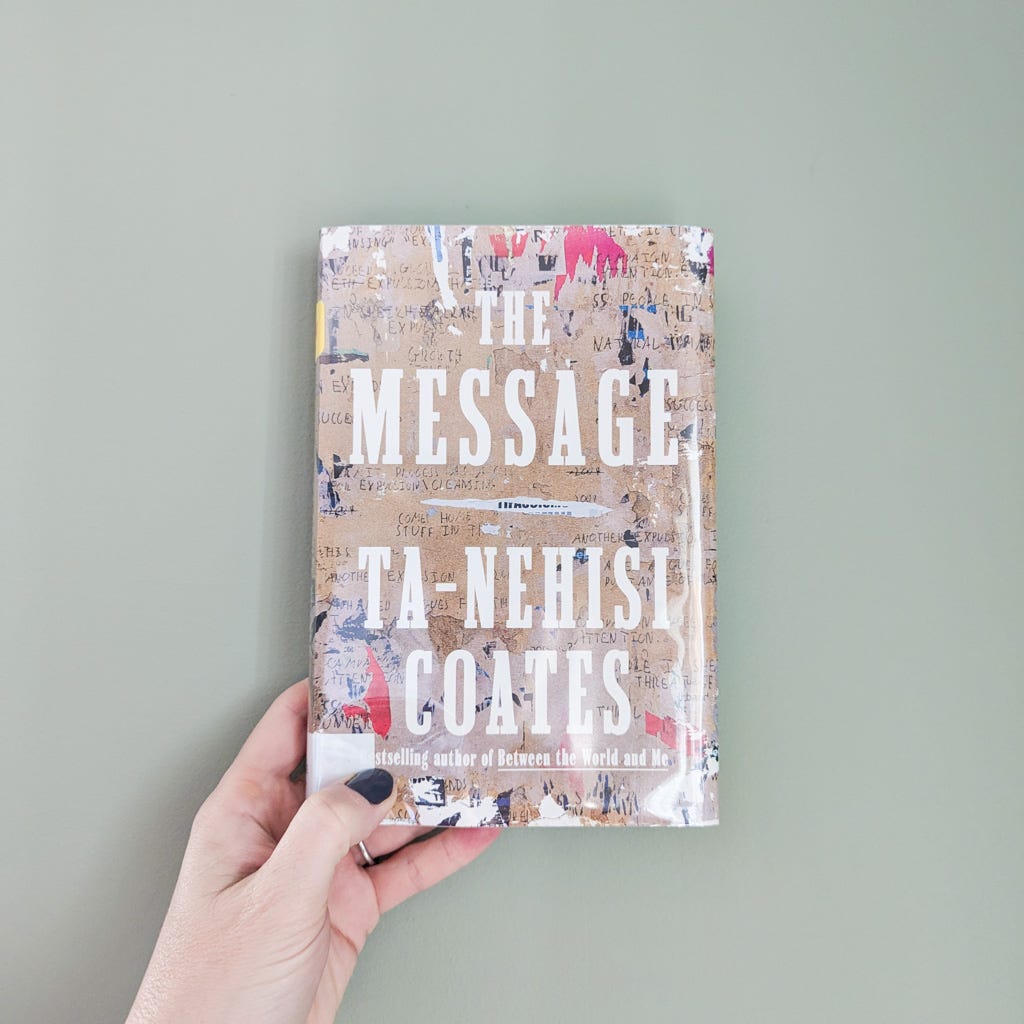
This book exemplifies and describes what Coates' work is all about—the power of words. Books provide a lens into new perspectives and insight into worlds we'll never experience. They question dominant narratives and challenge those in power who seek to control narratives for self-preservation. Preventing critical conversations is precisely the appeal of banning books; it's about controlling content and limiting knowledge.
Particularly under this new American government regime, I wouldn't be surprised if we see all Coates' books banned (some already have been banned, including The Water Dancer, which I read many years ago and was really good). They're exactly the types of books the dominant class of white Christian men grasping for power seek to silence.1
His books aren't lewd or sexual. Instead, they question the singular narrative of history and culture we're most often taught in school that protects power. This narrative projects American exceptionalism led predominantly by white, Christian men. Coates says:
“the threat of the storyteller who can, through words, erode the claims of the powerful."
Recently, the rising power of women, non-white people, and non-Christians threatens the comfort of power. It creates discomfort in a world where the balance of power is shifting. Long-held power forces are pushing back, as we might expect.
Book banning and silencing critical voices shut down the stories and truths that prompt us to question our society's power structure. Coates' book is one voice in the chorus of writers and communicators challenging the preservation of the status quo.
three intertwining essays
Coates writes three distinct but intertwining essays about his trips to Senegal, South Carolina, and Gaza in this book. In each essay, he examines how we can untangle ourselves from destructive nationalist myths of exceptionalism that shape our world. Instead, we can embrace the liberating power of confronting even the most difficult truths.
senegal
In the book's first section, he describes his visit to Dakar, Senegal, and the Last Door. This place represents the departure point for enslaved people being taken from Africa to North America on their tragic journey to slavery.
There's much to learn from his experience that is not often shared in mainstream history courses. He notably points out that how we lead our lives is influenced by the canon of words that inform our education. Words define our opinions, direct our actions, and shape our souls.
He says about his father and the stories that shaped society around him:
"I think if he tried to describe the forces shaping his life, my father would see his own actions first: his credits, his mistakes. But if you widened the aperture to the world around him, he would see that some people's credits earned them more, and their mistakes cost them less. And those people who took more and pay less lived in a world of insidious wealth, while his own people lived in a world of terrifying want. And what my father would have also seen is that he was confronted not just by the yawning chasm between wealth and want, but by the stories that sought to describe that chasm as natural. He would have pointed to the arsenal of histories, essays, novels, ethnographies, teleplays, treatments, and monographs, which were not white supremacy itself, but it's syllabus, it's corpse, it's canon."
south carolina
In South Carolina, he explores his experience meeting with people who have used his work for educational purposes - professionally and personally. He learns how it shaped their lives and opinions and threatened their careers as they pushed back against banning his work in their community. Once his work is out in the world, the words become an entity unto themselves with their own path to forge and stories to influence. His words have power, even without him in the room. He writes:
"I imagine my books to be my children, each with it's own profile and way of walking with the world. I see my books this way because it helps me remember that though they are made by me, they are not ultimately mine. They leave home, travel, have their own relationships, and leave their own impressions. I've learned it's best too as much as possible, stay out of the way and let them live their own lives."
gaza and palestinians
On visiting Palestine, he argues we have systematically excluded the voices of Palestinians in our media and writing communities so they cannot share their stories. In so doing, we've allowed and accepted the narrative of Israel as a "democracy" despite its methods of ethnic cleansing and colonialism. Israel stole land from Palestinians and operates under an apartheid system; it's the only way a Jewish minority could run a nation inhabited by Palestinians as a majority.
He writes about his visit to Israel and how what he saw in person contradicted the narrative we learn in the United States so profoundly. He sees many parallels between Israel and the American South during the time of Jim Crow. He argues compellingly that the United States wasn't a democracy until the Civil Rights Movement. At that point, everyone had agency and the right to vote (without intentionally absurd and artificial barriers). Under the same pretense, Israel is not a democracy now.
one perspective among many
Coates is a notably progressive writer. Not all share his perspectives. But with this book, he's doing exactly what he says the point of writing is—to allow readers to see the world in new ways and consider new ideas. Contemplation of words offers critical thinking opportunities and a chance to dismantle the dogma we've been taught in favor of creating our understanding of history and society based on a cornucopia of ideas.
This book provides a new viewpoint on Senegal and Gaza that helps me understand those who prioritize Palestinian freedom so fiercely. It doesn't answer all my questions or even begin to make me an expert in anything related to the matter.
However, Coates's words about his experience provide new details and perspectives on a conflict beyond my current historical knowledge. It's a book that can help me and that neighbor or friend who's a passionate advocate for Palestinian freedom, for example, find a connection in a conversation about the war and how it might come to a fair resolution.
Words have power. They shape who we are and who we become. They influence our relationships with others. And they inform how we move forward in all aspects of life.
book banning prevents progress
This book exemplifies, explicitly by design and implicitly by its contents, why book banning is so powerful and dangerous. Whether you agree with him or not, Coates shares perspectives on history and current events through the eyes of a population significantly underrepresented in published works.
In most instances, he does not state facts but expresses viewpoints contrary to the mainstream. Maybe he's right, and he's speaking truth to power. At the very least, his eloquent words challenge the status quo and encourage critical reflection on the story being told by the people in power.
As book banning escalates and will likely soar under a new presidential administration, particularly one seeking to close the Department of Education, let his work be a reminder that words have power. They have the power to preserve the status quo and challenge it. We need the latter to hold accountable all those who lead us toward a hopefully brighter and more elevated future.
hear more from coates
Coates has been on tour promoting his book. Here are two places I’ve heard him speak about it. I appreciated his thoughtful insights, which expanded on the words in the book.
The Daily Show with Jon Stewart
** Links to books are affiliate links through Bookshop and Libro.fm. They have no impact on your purchase price. Thanks for supporting my work!
💛 Do you enjoy this space? I’d love for you to share it with a friend and/or hit the HEART at the top or bottom of this newsletter. It helps more people find Borrowed Words and Sage Neighbor (and totally makes my day). TIA 💛
Of course, not all white Christian men feel this way. But the group that seeks to ban books and preserve the status quo is most certainly trying to secure power for the white, Christian patriarchy.